eSIM vs physical SIM: which should you actually use?
9 min read
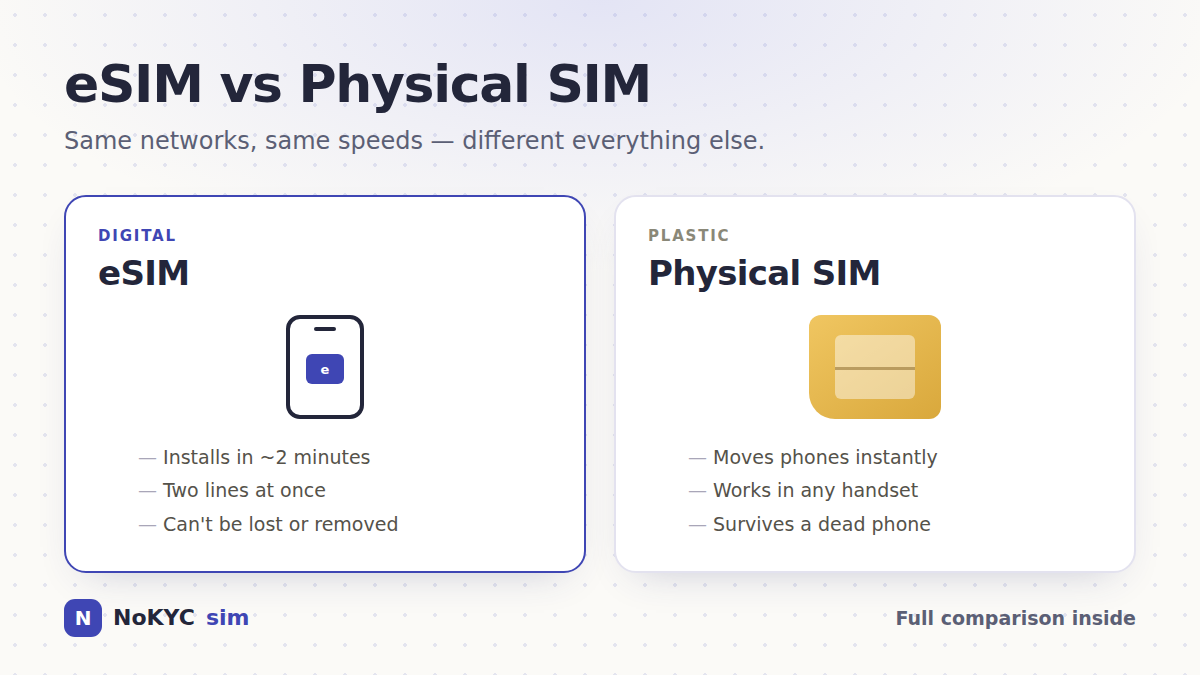
An eSIM is a SIM card built into your phone as software instead of a removable chip. For most people an eSIM is now the better choice: it installs in about two minutes, lets you run two lines at once, and can't be lost, damaged or swapped out of a stolen phone. A physical SIM is still better in three cases — moving your number between phones often, using older or dual-SIM budget handsets, or travelling somewhere you'll want a cheap local prepaid card from a shop.
| eSIM | Physical SIM | |
|---|---|---|
| Getting connected | QR code by email, ~2 minutes | Buy or post a card, then swap trays |
| Switching phones | Re-download or transfer the profile | Move the card in seconds |
| Lines at once | Several stored, usually 2 active | One per physical slot |
| Can be lost or damaged | No — it's software | Yes — it's a tiny piece of plastic |
| Thief can remove it | No | Yes, in seconds |
| Travel setup | Installed before you fly | Bought at the airport or posted |
| Identity needed to buy | Depends on the seller | Passport in 150+ countries |
| Signal and speed | Identical — same networks | Identical — same networks |
| Older phone support | iPhone XS+, Pixel 3+, S20+ | Essentially every phone |
What is actually different between an eSIM and a SIM card?
Less than most people expect. In the eSIM vs SIM card debate, both sides are SIMs — the credentials that identify you to a mobile network. The only real difference is how those credentials get into your phone. A physical SIM stores them on a removable chip you push into a tray. An eSIM stores exactly the same thing on a chip permanently soldered inside the phone, and the credentials are downloaded onto it as a 'profile'.
That single change — delivery by download instead of by plastic — is where every other difference comes from. Nothing about the radio, the network, the coverage or the speed changes. An eSIM and a physical SIM on the same carrier connect to the same towers and get the same signal.
Benefits of an eSIM: where it clearly wins
You can be connected in two minutes, from anywhere
This is the big one. A physical SIM has to physically reach you: a shop visit, a delivery, or an airport kiosk queue after a long flight. An eSIM arrives as a QR code in your inbox and installs over Wi-Fi. For travel that's transformative — you land already connected instead of hunting for a counter with your bags.
Two numbers on one phone, without a second slot
Modern phones store multiple eSIM profiles — typically eight or more — and run two lines at the same time. That means a work number and a personal number on one device, or your home number for calls and texts while a travel data plan handles the internet. Doing that with physical SIMs requires a dual-SIM phone and constant tray swapping.
It can't be lost, damaged, or pulled out of a stolen phone
Physical SIMs are tiny and get lost, bent, or left behind in a hotel-room tray. There's also a security angle people rarely think about: a thief can eject a physical SIM in seconds, which both defeats tracking and lets them receive your SMS codes. An eSIM can't be removed without unlocking the phone.
Switching plans stops being a chore
Because a profile is just a download, changing carriers or adding a short-term travel plan takes minutes and no paperwork. It also makes plans genuinely disposable — buy data for a two-week trip, let it expire, delete the profile.
eSIM disadvantages: where physical SIMs still win
Any honest set of eSIM pros and cons has to cover the trade-offs, because there are real ones.
- Moving to a new phone is harder. A physical SIM moves in five seconds. An eSIM has to be transferred or re-downloaded, and some carriers make you call support or issue a new QR code. If you swap handsets constantly, this is genuinely annoying.
- A dead phone is a bigger problem. If your handset won't power on, you can pull a physical SIM and put it in a spare phone immediately. An eSIM profile is stuck on the broken device until the carrier reissues it.
- Device support isn't universal. eSIM needs a reasonably recent phone — broadly iPhone XS or newer, Pixel 3 or newer, Galaxy S20 or newer. Budget and older handsets often have no eSIM at all.
- Profiles usually install once. Delete an eSIM by accident and you often need the carrier to reissue it. A physical SIM you deleted nothing from just keeps working.
- Local prepaid deals can still be cheaper. In some countries a shop-bought tourist SIM offers more data per dollar than any eSIM — if you don't mind the queue and the passport scan.
- Carrier support can be patchy. Some smaller networks and prepaid brands still don't offer eSIM provisioning at all.
Should you switch to an eSIM? Pick by scenario
You travel internationally → yes, switch
This is the strongest case. Travel eSIMs are cheaper than carrier roaming, install before departure, and let your home number stay active for calls and texts while data runs over the travel plan. You also skip the airport SIM counter — which in most countries now requires a passport scan and registration form.
You want a work and personal line → yes, switch
Two active lines on one phone is exactly what eSIM was designed for, and it beats carrying a second device or swapping trays.
You change phones often, or keep a backup handset → stay physical
If you routinely move your number between devices, or you want the ability to drop your SIM into an old phone the moment the main one dies, plastic still wins on sheer convenience.
You care about privacy → it depends entirely on where you buy
This is the nuance almost every comparison misses. The eSIM technology itself is neither more nor less private than plastic — what matters is what the seller asks for. Local physical SIMs require passport registration in over 150 countries. Travel eSIMs are provisioned internationally and connect through roaming agreements, so those domestic registration rules don't attach to them. Whether your purchase is anonymous then comes down to whether the store demands an account, a card and an ID.
Does your phone support eSIM?
Two things have to be true: the phone must have eSIM hardware, and it must be carrier-unlocked. Quick checks — on iPhone, open Settings → General → About and look for an EID number; on Android, Settings → About phone → SIM status, or look for an 'Add eSIM' option under network settings. If an EID exists, you have eSIM hardware.
- Apple: iPhone XS, XR and every model since (in the US, iPhone 14 and later are eSIM-only).
- Google: Pixel 3 and every model since.
- Samsung: Galaxy S20 and later, Z Flip and Z Fold series, and recent A-series models.
- Others: most 2022-onward flagships from Motorola, OnePlus, Oppo, Huawei and Sony.
Carrier locking catches people out more often than hardware. A phone bought on a carrier contract may refuse other profiles until it's paid off — on iPhone, Settings → General → About → Carrier Lock should read 'No SIM restrictions'.
Can you switch back from eSIM to a physical SIM?
Usually yes, provided your phone still has a SIM tray. Your carrier can move your number from an eSIM profile back onto a physical card, though most will charge a small fee and issue a new SIM. The exception is hardware: US iPhone 14 models and later have no tray at all, so on those there's no going back.
You don't have to choose exclusively, either. The most practical setup for most people is both at once — keep your main number on a physical SIM or primary eSIM, and add travel data plans as secondary eSIM profiles you delete when they expire.
The verdict
For most people in 2026, an eSIM is the better default. It's faster to get, impossible to lose, more secure against theft, and it makes second lines and travel plans trivial. Keep a physical SIM if you hop between handsets constantly, rely on an older or budget phone, or want the reassurance of moving your number to a spare device in seconds.
If you're switching for travel specifically, the practical next steps are picking a data plan for where you're going and installing the profile before you fly — our step-by-step guides for iPhone and Android cover the two-minute setup.
The one thing that genuinely doesn't differ is the connection itself. Same networks, same coverage, same speeds — so the decision is entirely about convenience, security and how you like to manage your lines.